
Galaxy Lithium Project
Analysis of Galaxy Lithium (Canada) Inc.'s proposed changes to the James Bay lithium mine project
Document reference number: 84
Draft report
March 2025
On this page
- List of tables
- List of Figures
- 1. Introduction
- 2. Proposed changes to the Project
- 3. Analysis of changes under the Physical Activities Regulations
- 4. Consultation and engagement
- 5. Assessment of potential adverse environmental effects
- 6. Conclusion
List of tables
List of Figures
- Figure 1. Map of proposed project changes.
- Figure 2. Proposed footprint of modified Project versus 2021 project footprint.
1. Introduction
Galaxy Lithium (Canada) Inc. (the Proponent) is proposing the construction, operation and decommissioning of an open-pit lithium mine. The project would be located in the territory of the James Bay and Northern Quebec Agreement (JBNQA), in the Eeyou Itschee territory, approximately 100 kilometres east of the Eastmain Cree Community, in Quebec. The proposed James Bay lithium mine project (the Project) would have an estimated life of between 15 and 20 years, with average daily ore production of 5,480 tonnes. The Project would include an open pit, an ore concentrator facility, storage areas for waste rock, tailings, ore and overburden, as well as related infrastructure.
The Project was assessed under the Canadian Environmental Assessment Act, 2012 (CEAA 2012). On January 13, 2023, the former Minister of the Environment and Climate Change decided that the Project was not likely to cause significant negative environmental effects and could proceed with federal permitting, subject to the conditions prescribed in the Decision Statement (Canadian Impact Assessment Registry [CIAR], reference number 80141, document 76). The Decision Statement contains 271 legally binding conditions, including mitigation measures and monitoring program requirements that the Proponent will be required to meet throughout the life of the Project. In July 2024, the Impact Assessment Agency of Canada (IAAC) issued an amended Decision Statement (CIAR, reference number 80141, document 78) to reflect changes to the Impact Assessment Act (IAA) pursuant to subsection 308(1) of the Budget Implementation Act, 2024.
Section 68 of the IAA confers legislative power on the Minister for the Environment and Climate Change to amend a Decision Statement to add new conditions or remove or amend existing conditions. The Minister must be of the opinion that the addition, deletion or modification of a condition does not increase the negative consequences assessed during the environmental assessment. The decision contained in the Decision Statement cannot be modified.
Condition 2.16 of the Decision Statement requires the Proponent to notify IAAC before proceeding with any proposed modifications to the Project. On January 17, 2024, the Proponent notified IAAC of proposed changes to the Project in the document titled De Galaxy Lithium (Canada) Inc. à l'Agence d'évaluation d'impact du Canada concernant l'avis pour les changements au projet de mine de lithium Baie James (CIAR, reference number 80141, document 80 – French only), which included the relocation of the west and northeast waste rock piles and the modification of the shape of the southwest waste rock pile. The Proponent also provided further information on May 8, 2024 in the document titled De Galaxy Lithium (Canada) Inc. à l'Agence d'évaluation d'impact du Canada concernant l'informations supplémentaires pour les changements au projet de mine de lithium Baie James (CIAR, reference number 80141, document 81 – French only) and on December 13, 2024 in the document entitled Additional information from Galaxy Lithium (Canada) Inc. to the Impact Assessment Agency of Canada on changes to the James Bay Lithium Mine Project - December 2024 (CIAR, reference number 80141, document 82).
IAAC conducted an analysis of the proposed changes, as well as potential adverse environmental effects that fall under federal jurisdiction, including impacts on the rights of Indigenous peoples, to determine:
- whether the changes constitute a new or different designated project under the Physical Activities Regulations (the Regulations) and would therefore require an impact assessment under the IAA;
- whether any changes (including addition or removal) may be required to the key mitigation measures and follow-up program requirements included as conditions in the Decision Statement.
IAAC's analysis is summarized in this report.
In parallel with the federal process, the Project is also subject to review at the provincial level by the Environmental and Social Impact Review Committee (COMEX). COMEX is an independent body under the authority of the Quebec Ministry of the Environment, the Fight against Climate Change, Wildlife and Parks (MELCCFP). Its mission is to assess and examine the environmental and social impacts of projects located south of the 55th parallel in the territory governed by the JBNQA. The Proponent will have to obtain various necessary authorizations from COMEX and MELCCFP for the relocation and modification of the waste rock piles.
2. Proposed changes to the Project
The Proponent proposes to modify its initial plan by adjusting the location and configuration of certain waste rock piles, as illustrated in Figure 1. Specifically:
- Relocation of the western waste rock pile: this will be moved 262 meters to the west-southwest following condemnation drilling carried out in 2022, which revealed lithium deposits below this area. This relocation meets the requirements of provincial regulations, which require mining infrastructure to be located away from mineralization zones.
- Relocation of the northeastern waste rock pile: this will be moved 60 meters to the north in order to move it away from the CE3 watercourse. This measure aims to reduce the risk of contamination and protect sensitive aquatic habitats.
- The modification of the shape of the southwestern waste rock pile: its contour will be adjusted to move it further away from the CE3 watercourse and to avoid the ponds to the south. This change does not affect its storage capacity.
These changes aim to limit the impact on water resources and minimize the environmental risks associated with proximity to aquatic environments.
The proposed changes would result in a 35.18-hectare increase in the area of the designated project zone, as shown in Figure 2. This represents a 7.8% increase on the overall footprint assessed in the 2022 environmental assessment (CIAR, reference number 80141, document 74).
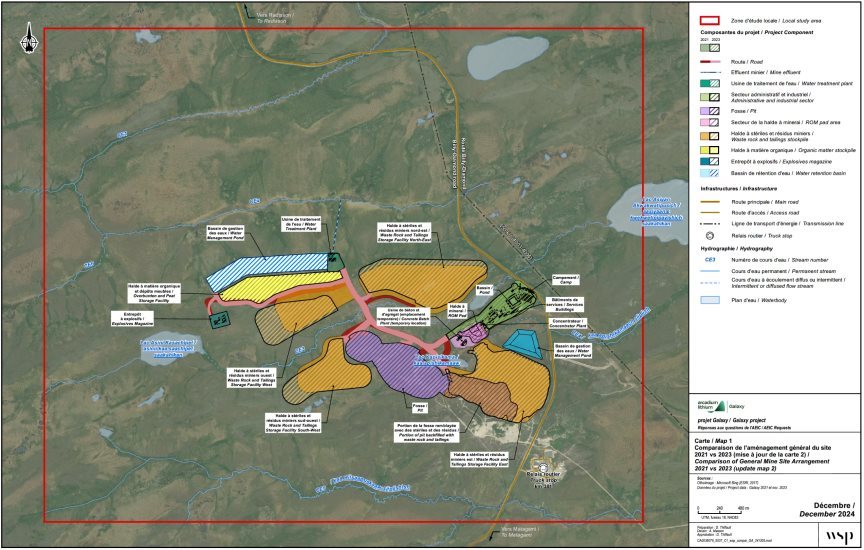
Source: Galaxy Lithium (Canada) Inc, December 2024
Figure 1 - Text version
Map of the project showing the proposed new locations of each project component overlaid on the original locations from the 2021 project description, as described in Section 2. The proposed new shape of the southwestern waste rock pile is longer and narrower than the original. Its northwestern edge is further from the CE3 watercourse. Its southwestern edge stretches beyond the original footprint, without encroaching on the ponds to the south. Minor modifications to other project elements remain largely within their original footprints.
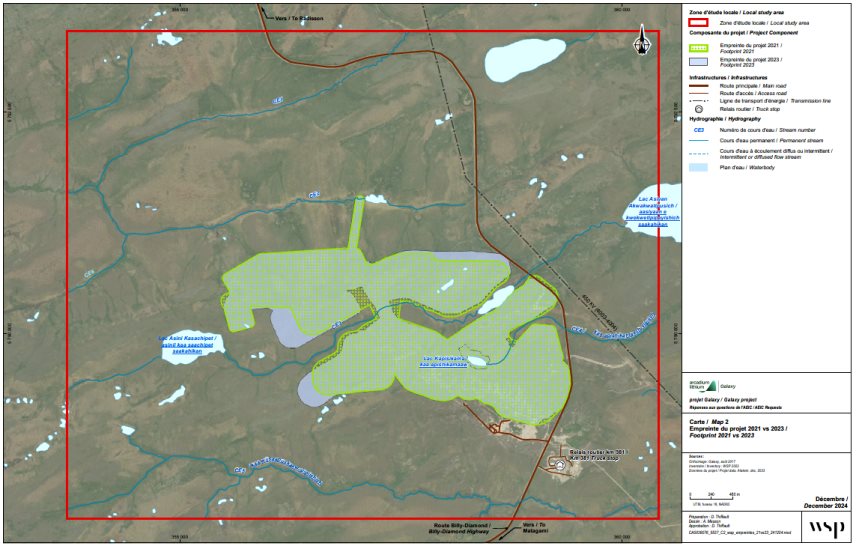
Source: Galaxy Lithium (Canada) Inc, December 2024
Figure 2 - Text version
Map showing the proposed new overall project footprint overlaid on the original footprint from the 2021 project description. The new footprint reflects the changes described in Section 2 and shown in figure 1.
3. Analysis of changes under the Physical Activities Regulations
The IAA Physical Activities Regulations describe which physical activities constitute designated projects that may require an impact assessment. Section 19(c) of the Physical Activities Regulations reads as follows:
19 The expansion of an existing mine, mill, quarry or sand or gravel pit in one of the following circumstances:
(c) in the case of an existing metal mine, other than a rare earth element mine, placer mine or uranium mine, if the expansion would result in an increase in the area of mining operations of 50% or more and the total ore production capacity would be 5 000 t/day or more after the expansion;
According to the Proponent's analysis, the waste rock piles will maintain the same surface area and storage capacity for waste rock and tailings. However, the Proponent mentions that there will be an increase of 35.18 hectares in the area of affected habitats compared to the area presented in the environmental assessment, increasing the mining area by a maximum of 7.8%, which remains below the thresholds specified in the Physical Activities Regulations.
The Proponent is not proposing to change the ore extraction rate, keeping it at about 5,480 tonnes per day as indicated in the original environmental assessment report.
Therefore, the IAAC is of the opinion that the proposed changes do not constitute a new or different designated project that might require a new impact assessment.
4. Consultation and engagement
Consultation with Indigenous groups, advice from federal authorities and public participation inform IAAC's analysis of proposed changes and IAAC's recommendations to the Minister.
4.1 Proponent's Engagement of Indigenous groups
In June 2023, the Proponent held initial consultations with the Waswanipi, Waskaganish and Eastmain communities, as well as with land users, focusing solely on the relocation of the western waste rock pile. Group information sessions and individual face-to-face meetings were organized in Eastmain to inform the community and the tallyman of the RE02 territory.
A second round of consultations was then held with the same communities to discuss all of the proposed changes. A public information session was held in Eastmain on September 4, 2024, followed by a face-to-face meeting with the Waswanipi community mining coordinator on September 17, 2024. In addition, the Proponent's representatives met with Waskaganish community authorities on October 23, 2024.
4.2 IAAC consultations on proposed project changes
As the Project is in JBNQA territory, IAAC is working with the Cree Nation Government (CNG) to analyze proposed changes to the Project. Several e-mail exchanges and virtual meetings took place between the CNG and IAAC as part of this analysis.
IAAC also sought the expertise of Environment and Climate Change Canada (ECCC), Fisheries and Oceans Canada (DFO), Health Canada (HC) and Natural Resources Canada (NRCan) to inform the assessment of potential adverse effects related to proposed changes to the Project, as presented below in Section 5.
In addition, IAAC will be seeking further comments from federal authorities, the CNG and the public on the proposed changes to the Project as part of the public consultation period. The results of the public consultation period will be taken into account in IAAC's analysis to provide advice to the Minister of the Environment and Climate Change on a final recommendation of potential amendments to the Decision Statement.
5. Assessment of potential adverse environmental effects
The following analysis seeks to determine whether the proposed changes would increase the extent to which the effects of the Project, as assessed during the environmental assessment, would be adverse. The analysis determined whether changes needed to be made to the mitigation measures and follow-up requirements included as conditions in the decision statement.
The review of the proposed changes to the Project took into account the potential impacts on several valued components. However, the detailed analysis focused on the valued components of fish and fish habitat and Indigenous peoples, as the current terms of the Decision Statement already cover the potential effects of the project changes on other components under federal jurisdiction, notably migratory birds.
5.1 Fish and Fish habitat
The effects of the Project on fish and fish habitat were assessed during the original environmental assessment of the Project. Mitigation measures and follow-up requirements were developed, and the Decision Statement includes related conditions, notably in Section 3.
5.1.1 Proponent's Assessment
The Proponent assessed the potential effects of project modifications on fish and fish habitat. According to its analysis, the relocation of the western waste rock pile will not result in any additional significant impact.
Rather, the relocation of the north-eastern waste rock pile and the modification of the shape of the south-western waste rock pile are intended to move these waste rock piles further away from aquatic environments, in particular the CE3 watercourse and the ponds located to the south of the southwestern waste rock pile. The stated aim of these adjustments is to reduce the risk of contaminating waterbodies and to protect sensitive aquatic habitats.
5.1.2 Views expressed
DFO considers that the proposed project modifications will not result in significant additional impacts on fish and fish habitat. The existing mitigation measures and monitoring requirements included in the Decision Statement are deemed sufficient to address the effects associated with the proposed project changes. In their opinion, no additional mitigation measures or monitoring requirements are necessary for the "Fish and Fish Habitat" component.
ECCC expressed several concerns about the effects of project modifications on water quality and its potential effect on fish and fish habitat.
ECCC recommended that the Proponent document the potential impacts of pit expansion on particulate matter deposition in the study area, as compared to the initial layout. The convergence of the western and southwestern waste rock piles of Lake Asiyan Akwakwatipusich could lead to an increase in the deposition of particulate matter and metals in the lake, due to emissions generated by activities on these waste rock piles, wind erosion and local weather conditions. The Proponent notes that, in fact, the waste rock piles are closer to Lake Asini Kasachipet. Nevertheless, the Proponent anticipates that particulate matter deposition will remain similar to what was predicted in the 2022 environmental assessment, since the quantity of material deposited in the pits will remain the same. In addition, the Proponent confirmed that, contrary to what might be interpreted from Map 2 of its January 2024 document, no modifications would be made to the pit or the north water management basin relative to what was outlined in the 2022 environment assessment.
Nevertheless, ECCC maintains that repositioning the western and southwestern waste rock piles could increase the deposition of particulate matter in nearby lakes and the four ponds along the southern flank of the southwestern pile. However, although additional deposits of particulates in the waterbodies are a predictable result of the project changes, their magnitude could be reduced by rigorous application of mitigation measures already outlined in the initial impact assessment as well as those stipulated in the Decision Statement conditions, notably the following: 7.1, 7.3, 7.6, 7.7, 8.16 and 8.17.
ECCC also indicated that the project changes could affect groundwater in the receiving environment, which could resurge in surface waters. The Proponent thus updated its modelling with the new waste rock pile positions and reports that the percolation rates for the western and southwestern waste rock piles are slightly higher than in the analysis of the previous design, while that of the northeastern waste rock pile remains unchanged. Regardless, the Proponent maintains that the percolation rates remain within the standards outlined in Directive 019 and would not cause significant impacts to the environment. For this purpose, ECCC is of the view that the mitigation measures outlined in the initial impact study and stipulated in the Decision Statement conditions, notably 3.9 and 3.18, would suffice to mitigate impacts on fish and fish habitat.
5.1.3 IAAC's analysis and conclusions
IAAC is of the opinion that the proposed project changes would not result in adverse environmental effects on fish and fish habitat that would alter the conclusions reached in the 2022 environmental assessment.
IAAC recommends that the geographical area of infrastructure be modified to include a reference to Figure 1 and Figure 2 of this report in Condition 1.43 of the Decision Statement. This will ensure that existing conditions in the Decision Statement apply to new infrastructure associated with the designated project, including conditions related to fish and fish habitat and progressive reclamation.
5.2 Indigenous peoples
The effects of the Project on Indigenous peoples were analyzed during the initial environmental assessment of the Project. Mitigation measures and monitoring requirements were developed, and the Decision Statement includes relevant conditions, notably in Sections 2, 5, 7, 8 and 10.
Three First Nations could be affected by the proposed changes to the Project: the Cree Nation of Eastmain, the Cree Nation of Waskaganish and the Cree First Nation of Waswanipi. The CNG represents the three First Nations in consultations with the Crown. The Project would be located in the territory covered by the JBNQA, in Eeyou Istchee, about 100 kilometres east of the Cree community of Eastmain, in Quebec.
5.2.1 Proponent's Assessment
According to the Proponent, the impact of relocating the west and northeast waste rock piles, as well as modifying the shape of the southwest waste rock pile, on Indigenous peoples is considered negligible. This work would be carried out on the waste rock piles furthest away from sensitive receptors, i.e. the truck stop at kilometre 381 and the hunting grounds located near the project area.
5.2.2 Views expressed
The CNG considers the environmental impacts of relocating the west and northeast waste rock piles and modifying the shape of the southwest waste rock piles to be minor, and the proposed modifications to be environmentally acceptable.
5.2.3 IAAC's analysis and conclusions
IAAC believes that by modifying the definition of the designated project area in Condition 1.43, as described in Section 5 of this report, the mitigation measures and monitoring programs mentioned in Sections 2, 5, 7, 8 and 10 of the Decision Statement would also apply to the project change, thereby helping to mitigate potential effects on species at risk of interest to First Nations, Cree health, current use of lands and resources for traditional purposes, and natural and cultural heritage and structures, sites or things of historical, archaeological, paleontological or architectural significance.
6. Conclusion
IAAC's provisional conclusion is that, based on the information provided by the Proponent and the various parties consulted, the proposed changes to the Project are not likely to cause significant adverse environmental effects beyond those described in the 2022 environmental assessment, taking into account the mitigation measures and monitoring programs included in the conditions of the Decision Statement.
Since the proposed changes to the Project are not included in the definition of a designated project as currently formulated in the Decision Statement, IAAC recommends that this definition be amended to include the expansion of the project area, as described in Section 2 of this analysis report. This amendment will ensure that the conditions included in the Decision Statement also apply to proposed changes to the Project. Table 1 gives details of the recommended amendment.
|
Last statement of decision published July 26, 2024 |
Recommended amendment to the Decision Statement |
|---|---|
|
Condition 1.8: Designated Project - the James Bay Lithium Mine project as described in Section 2 of the environmental assessment report prepared by the Canadian Impact Assessment Agency (Canadian Impact Assessment Registry, reference number 80141). |
Revised Condition 1.8: Designated Project - the James Bay Lithium Mine Project as described in Section 2 of the Environmental Assessment Report prepared by the Canadian Impact Assessment Agency and Section 2 of the Analysis Report prepared by the Canadian Impact Assessment Agency Analysis of Galaxy Lithium (Canada) Inc.'s Proposed Changes to the James Bay Lithium Mine Project (Canadian Impact Assessment Registry, reference number 80141). |